
Workforce problems that hide between the numbers
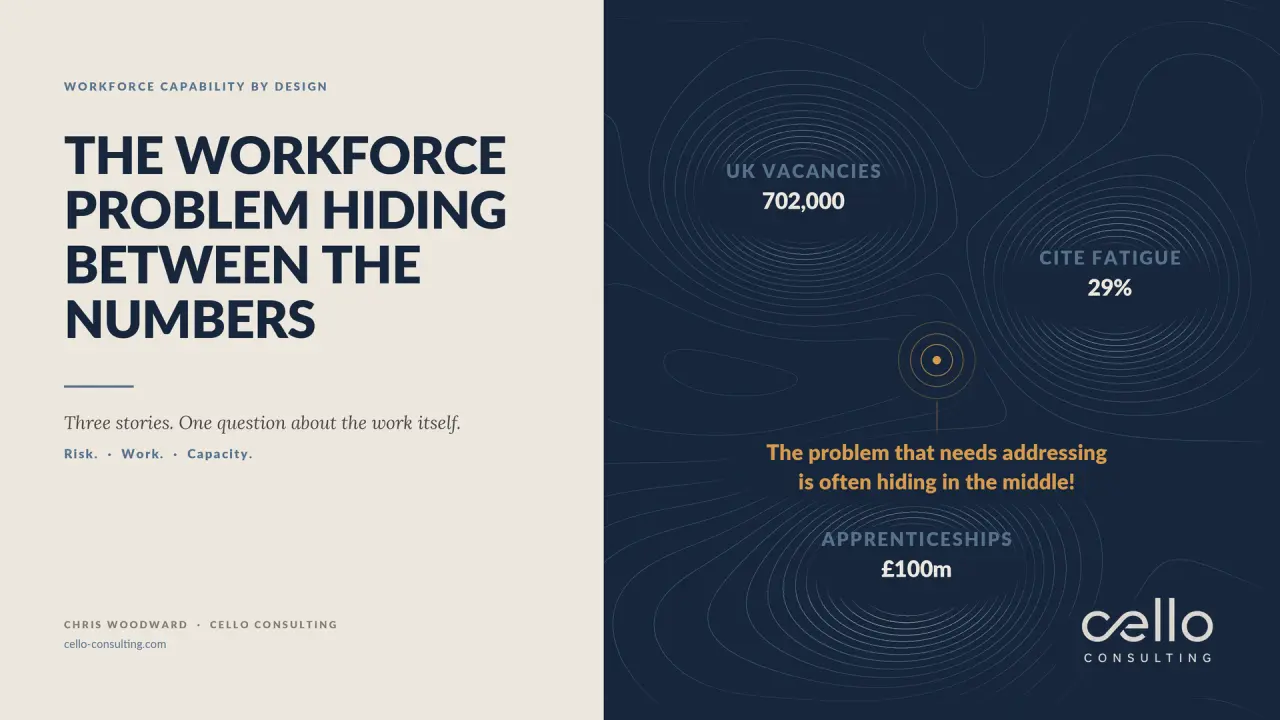
There is a particular kind of executive meeting in which everybody's figures are correct but the decision is still wrong! It's wrong as it fails to answer the real problem: the issue that is a consequence of multiple different, but related, factors. We see this a lot in SWP.
Finance shows a lower vacancy number. HR shows people leaving roles they cannot readily replace. Operations shows work piling up. The training team shows a new programme. Nobody is being careless. The difficulty is that each number describes a different part of the same system.
Three recent UK stories make this problem unusually visible. In isolation they stand on their own (and can be mitigated in isolation). When seen together they address what I believe to be the real issue, one that can't be resolved by tackling the issues in isolation. Let me explain...
ONS estimated 702,000 vacancies for June to August 2026, while the CIPD and Omni RMS found 44% of surveyed employers said retention had become harder. PwC's survey of more than 2,000 workers found that fatigue and burnout (29%), workload (28%) and poor management or decision-making (25%) were cited as productivity barriers more often than a lack of skills or training (13%). The Chancellor has announced £100m over two years to extend local apprenticeship services across all 14 mayoral strategic authorities in England from spring 2027. Meanwhile, Learning and Work Institute reports that employers invest 29% less per employee in training than in 2011.
These are different studies with different questions and time periods. They do not prove a single cause. Read together, though, they suggest a useful test for any workforce strategy:
Are we designing work, capability and development capacity to fit the commitments we have made?
A quieter labour market can conceal a sharper risk
A vacancy total tells us something about the national labour market. It tells us much less about a particular capability holding up your next programme milestone. The CIPD reports that 53% of employers who tried to recruit in the past year had difficulty attracting suitable candidates, particularly in senior and skilled positions. That is a more useful prompt for an executive team than a general verdict that hiring is now 'easy' or the market is 'tricky'.
I have worked in engineering environments where a small number of roles carried an outsize share of delivery risk. Conversations with business leaders often needed to be manoeuvred from the default setting of: 'how many positions are open and need filling' to 'what work depends on them, does the knowledge or expertise exist elsewhere, how long will it take for someone to become competent and what options remain if normal supply options fail'?
This is where workforce criticality should begin. Not with the most senior titles, the loudest vacancy requests or a universal label of 'business critical', but with consequences. A criticality exercise enables you to contingency plan better, locking in those capabilities that matter most while breathing innovation into your resourcing strategies. Where would a capability gap delay delivery, compromise a control or make a strategic promise untenable? And what could change in how work is done to reduce dependence on one person or one route into the role?
What workers say is getting in the way
In PwC's Hopes and Fears Survey, the findings are about workers' reported barriers to productivity, not a measurement showing training has little value. Skills (and the management of them) still matter greatly, particularly when technology and work are changing at a pace. But if fatigue, workload and decisions are what people experience first, another learning intervention alone will have a limited chance of making the work flow better.
Most roles acquire tasks over time. A new report, another approval, a system workaround, a well-intended request from a senior colleague: each addition is reasonable in isolation. Very few arrive with a note identifying what should stop. After a few years, the job description can be a tidy account of a role that no human being actually has time to perform.
That is why I would ask three questions before approving a capability investment. What work must be done? How is it distributed and managed today? What would a well-supported person need to do it safely and well? Sometimes the answer is training. Sometimes it is a clearer decision right, a removed handoff, a redesigned role or a manager resourced with dedicated time to develop others at scale.
There is a humane point here as well as a commercial one. When people tell us their workload is unmanageable, we should be slow to translate that into a personal deficit. They may be describing a system that asks for more than it has made possible.
Apprenticeships need more than an entry point
The government's £100m expansion of local apprenticeship services is a welcome attempt to connect young people and employers. A separate £2,000 hiring payment for eligible non-levy employers taking on 16-to-24-year-old apprentices starts in October 2026. Those measures address access and cost. However, employers will still need to make room for learning to happen at work.
In early careers planning in engineering, one of the most consequential questions was also one of the least glamorous: who will supervise the new people, how will they do this and how much time is required to do this well? An apprenticeship place is a commitment by experienced colleagues, managers and the organisation, as well as by the apprentice. If expert workers are already carrying too much, simply increasing intake can leave both apprentice and supervisor short of support. It quickly turns demoralising on all counts.
Learning and Work Institute's analysis found that training per trainee fell from 7.8 days in 2011 to 5.7 days in 2024. That does not tell us whether a particular employer can support an apprenticeship. But it does remind us that development capacity is a real resource, and that funding a place does not automatically create it or optimised learning environments.
For a 2027 intake, I would look at future demand, the pipeline's time to competence, the availability and preparation of supervisors, and the work that apprentices will genuinely be able to learn. It is a better discussion than celebrating a target number of places before anybody has counted the people who will teach them.
Now more than ever, young people will be most attracted to organisations that offer the first 8-10 years of their career, developing their profession, rather than organisations that just offer a well paid entry level role.
One decision system, several ways to intervene
In Edition 02, I described six places where strategy stops becoming capability. This week's stories show how three seemingly unrelated issues are in fact part of the same workforce capability system: strategic demand that has not been translated into critical capability, roles that have accumulated more work than their design can carry, and a future talent pipeline without an honest view of the capacity needed to grow it.
No organisation needs to launch six projects to respond to this. Rather, it needs a way for Strategy, Finance, Operations and HR to examine the same decision so that the risk to strategy execution can be mitigated efficiently and innovatively.
Cello's six connected modules design and develop solutions and your teams, creating a system that gives that conversation a structure and enables decision insights at the right time. They are:
- Strategy to Capability - defining, deriving and mapping organisational capability
- Capability Frameworks - creating a common currency for talent and capability
- Integrated Business Planning - enabling good governance and collaborative planning that locks in a joined up view of workforce demand
- Strategic Workforce Planning - defining the purpose for, and implementing SWP as the engine room that drives decision insights
- Workforce Criticality - helping you determine risk and priorities, enabling better decision quality
- Workforce Strategy - creating resourcing strategies that are innovative and agreed that directly derisk and optimise business strategy execution.
They can be examined individually, but the value comes from operating them as a system.
My approach begins with a modest question: what decision are you trying to make, and what evidence would change it? Sometimes a quick diagnostic or an executive workshop is enough to find the real constraint. Sometimes the answer is a deep dive, a transformation design, hands-on implementation or continuing advice as the plan meets reality.
This is the work of Cello Consulting: we design and build workforce management systems with the people who will have to own it, developing them along the journey.
The national figures are useful. The local questions are sharper. Which capability is exposed? Which work is poorly designed? Who has the time to develop the next generation? Put those answers in one room and a workforce strategy becomes a set of choices that people can actually act on.
Perhaps the most helpful thing HR can say to the executive team this autumn is neither 'we need more people' nor 'we need more training'. It is: let's look at the work, the risk and the capacity to change them, together.
Author: Chris Woodward FCIPD MBA. 8th Oct 2026
Chris Woodward is a former Army Officer, the former Head of HR at the OECD, ex KornFerry and Babcock's former Global Head of SWP. He is the founder of Cello Consulting, supporting clients across sectors to design and deliver bespoke workforce capability systems and strategies that derisk strategy execution and deliver business value.
Selected sources
· Office for National Statistics, Vacancies and jobs in the UK: September 2026
· CIPD and Omni RMS, Resourcing and talent planning 2026
· PwC, UK Hopes & Fears Survey, 29 September 2026
· HM Treasury, apprenticeship announcement, 28 September 2026 and apprenticeship funding guidance
· Learning and Work Institute, employer investment in skills, 7 September 2026