
From People Analytics to Workforce Capability
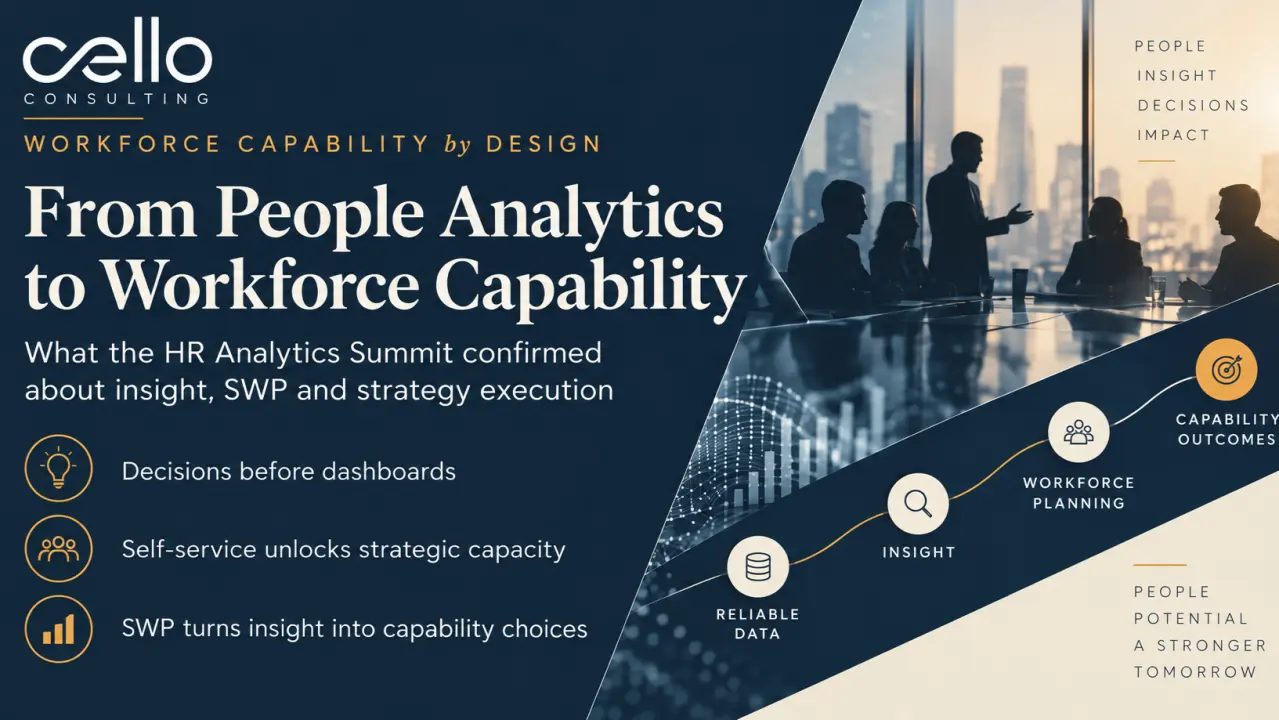
What the HR Analytics Summit on 3rd September 2026 confirmed about insight, SWP and strategy execution
I went to the HR Analytics Summit expecting to spend a day thinking about data. I came away thinking much more about better decision making.
Across sessions on People Analytics maturity, Board reporting, self-service solutions, AI and Strategic Workforce Planning, the same issue kept appearing in different forms.
Organisations do not necessarily need more people information, they need to become much better at turning information into workforce choices that improve the chances of delivering the strategy.
Sounds obvious doesn't it but in practice it happens much less than we think!
Why? Because there is a significant difference between knowing something about your workforce and knowing what to do differently because of it... and somewhere between these two sits a capability that HR functions increasingly need to build. This is where Cello comes in.
1. Insight is only useful when it changes a decision
One of the clearest messages from the day was that strong People Analytics teams start with the enterprise agenda rather than the HR agenda.
The conference evidence suggested that more mature people analytics teams are much more likely to have their priorities shaped by C-suite priorities and business strategy and to measure the value they create. The largest maturity gap wasn't in producing workforce experience data, it was in demonstrating impact on business performance.
This is an important challenge for HR Directors when you think about it as it has the potential to evidence significant value-add from the function amongst EXCO peers.
A beautifully constructed dashboard does not create value merely because it contains accurate information.
A more useful test is, sadly but obviously, more demanding: What does this tell us that changes a decision?
Take turnover. "Turnover amongst data scientists is 18%" tells us what has happened.
Explaining what that means for delivery capacity, replacement cost, customer commitments, future revenue or transformation milestones starts to turn the number into insight. From insight opportunities are seized and risks mitigated quicker, saving or making businesses money.
Connecting these insights to decisions: build capability internally, change retention investment, redesign the work, recruit elsewhere, automate part of it — turns analysis into action.
Boards do not need HR to make the data simpler for its own sake. They need the people implications of strategy expressed in a language they already use: cost, risk and opportunity. That was also the logic behind one of my favourite observations from the Summit: graphs can illustrate the evidence, but insight has to drive the decision.
2. Self-service isn't really about dashboards
A second thread initially looked much more operational: Self-service analytics.
But underneath it was a strategic capability problem. When skilled People Analytics practitioners spend large amounts of their time producing routine reports, answering ad-hoc queries and resolving basic data questions, there is an obvious opportunity cost.
Root-cause analysis, scenarios, predictive work and strategic workforce insight require concentration. You cannot continually interrupt that work with another request for last month's headcount.
One Summit example described a self-service transformation in a 70,000-person organisation that ultimately released more than 70% of the analytics team's capacity while serving thousands of operational users and line managers.
The lesson wasn't simply "build a portal or dashboard".
The supporting conditions mattered: reliable data, a clear service channel, access designed around users, proportionate security, consistent user experience and, critically, leadership backing to make self-service the user default setting.
That creates an interesting strategic equation: better access to routine information creates more capacity for difficult questions.
For an HR Director, this is an interesting business case.
Don't measure self-service only by dashboard adoption; measure what your analysts can now do that they previously couldn't.
- Can they investigate capability risk?
- Can they integrate internal and external labour-market evidence?
- Can they model scenarios?
- Can they work with Finance and Strategy on the assumptions underneath a transformation?
- Can they tell leaders something about the future rather than simply report the past?
That is a much more valuable return.
3. SWP is the bridge between insight and capability
This leads to the part of the Summit closest to my own work: Strategic Workforce Planning.
Traditional workforce planning can follow a deceptively logical path:
Demand → roles → skills → headcount.
But that can embed the current organisation into the answer before we have properly understood the question. A more useful sequence raised during the Summit was:
Demand → work → tasks → decision.
That shift is important because demand for an outcome does not necessarily translate into equivalent demand for people, especially now with AI. As a trained Exec Coach, I learned to ask the right questions at the same time and this is relevant here too. For example before recruiting, ask:
- What work actually needs to exist?
- What creates value?
- Which tasks could be removed?
- Which could be redesigned?
- What can technology augment or automate?
- What existing capability could be redeployed?
- What genuinely needs to be built internally?
- And where does buying capability externally make more sense?
Suddenly your workforce conversation contains options.
Build. Buy. Redeploy. Automate. Redesign.
This is where I think SWP earns the word strategic. Not by forecasting a headcount number further into the future, but by providing a structured way of translating strategic change into decisions about work, capability and workforce intervention.
- People Analytics provides evidence.
- Talent intelligence expands our understanding of supply and the external market.
- SWP connects demand and supply and creates choices.
- Workforce strategy decides what we will actually do.
4. AI makes this more important, not less
AI appeared throughout the conference, unsurprisingly, but one observation stood out. Tracking AI adoption tells you very little about what has actually happened to the work.
The workforce question isn't simply: "Who is using AI?", it is:
What work is changing because of AI, which tasks are being augmented or removed, what new capability is emerging, and what does that mean for workforce demand?
The conference material explicitly framed AI as increasing rather than reducing the requirement for good people intelligence. I agree.
AI makes static workforce assumptions decay faster, it increases the importance of understanding work, not merely jobs, and it increases the value of a planning capability that can revisit assumptions as the evidence changes.
From analytics maturity to workforce capability
Put these ideas together and the relationship becomes clearer:
Strategy creates the question. People Analytics strengthens the evidence. SWP translates the evidence into capability choices. Workforce strategy turns those choices into action.
None works particularly well in isolation. That's also why I have become increasingly wary of transformations that solve only one component; a skills taxonomy without proper governance and integration becomes a catalogue; excellent People Analytics without sufficient capacity becomes a reporting service. SWP without credible data creates false precision. A workforce strategy without governance becomes... a document.
At Cello Consulting I structure workforce transformation around six connected modules:
- Strategy-to-Capability Planning — translating strategy into the work and capability required.
- Capability Framework, Management & Development — establishing a practical common language connecting people to work.
- Strategic Workforce Planning Maturity — developing demand, supply, scenarios and intervention capability.
- Integrated Planning & Governance — connecting workforce decisions to Strategy, Finance and Operations.
- Talent Criticality & Workforce Risk — separating what is genuinely critical from what is simply scarce, senior or visible.
- Workforce Strategy Credibility — converting the evidence into affordable, owned and executable choices.
They are linked deliberately. The aim isn't six HR programmes. It is
One workforce capability system that helps leaders make better decisions and execute strategy with greater confidence.
Cello also uses a unique transformation methodology: DESIGN — Diagnose, Envision, Shape, Implement, Grow and Navigate — across the whole transformation and recursively within individual modules, with an emphasis on transferring the method and capability to the organisation rather than creating long-term consultant dependency.
Ultimately, my biggest takeaway from the Summit was that the future of People Analytics isn't more analytics, it's using evidence to understand what is changing, making better choices about work and capability, and giving leaders the confidence to act.
Insight matters when it changes the workforce decision.
If any of these questions are live in your organisation, leave me a message or bring the problem to a short introductory conversation. No polished brief needed.
https://calendly.com/chris-cello-consulting/quick-intro-call